
Standard Solar Panel Orientation for Optimal Efficiency
10/01/2026 · 3 min read
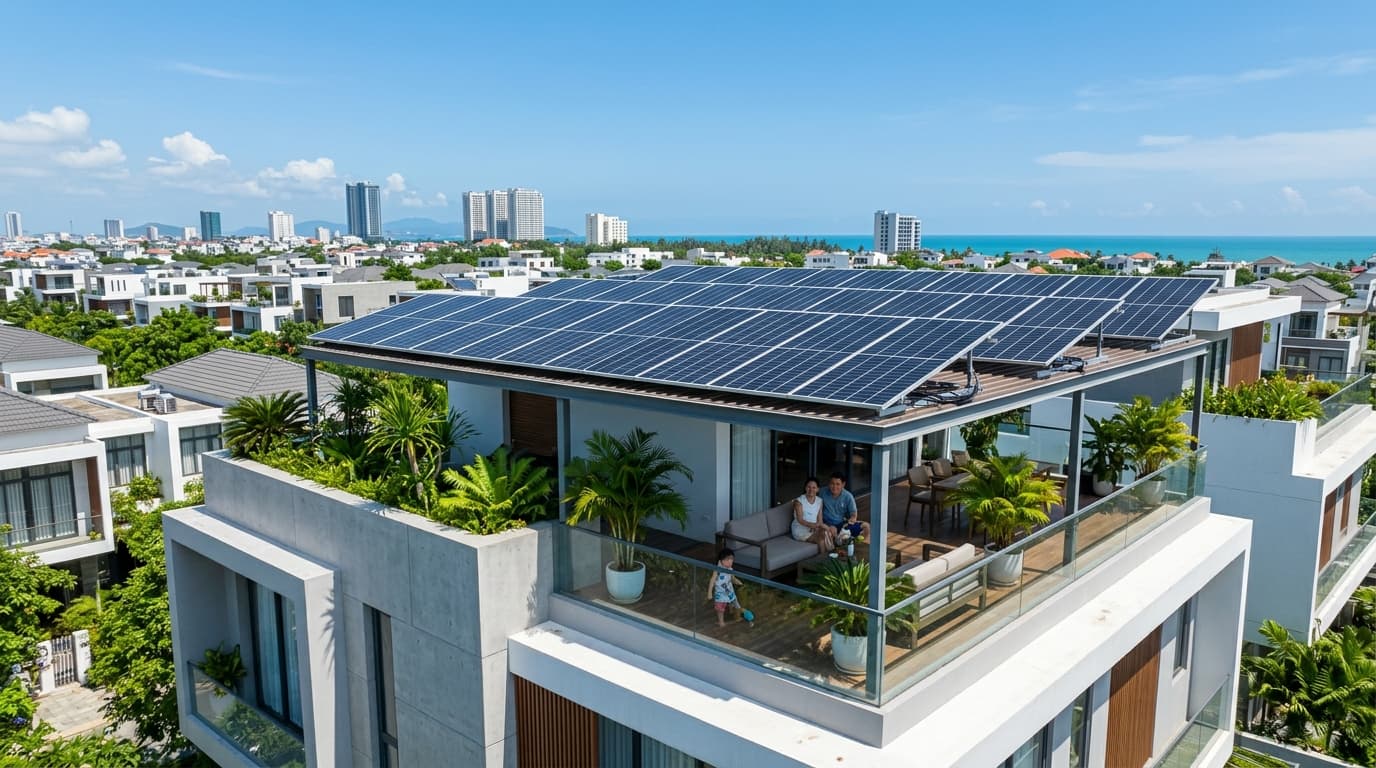
When investing in solar energy, determining the correct solar panel orientation plays a decisive role in the total power yield generated throughout the project's lifespan. An incorrect orientation or inappropriate tilt angle can result in a 10% to over 30% drop in designed capacity, prolonging the investor's payback period.
Why Does Solar Panel Orientation Directly Affect Power Output?
Solar panels operate based on the photovoltaic effect, converting solar radiation directly into electrical current. Power generation reaches its peak when sunlight hits the surface of solar cells perpendicularly (at a 90-degree angle).
Because the sun's trajectory continuously changes throughout the day and across seasons, orienting the racking system to capture the highest cumulative irradiation is an engineering challenge that requires careful calculation rather than guesswork.
Which Direction Should Solar Panels Face in Vietnam?
Vietnam lies entirely in the Northern Hemisphere (approximately from 8° to 23° North latitude). Due to this geographic characteristic, the sun tends to incline toward the South for most of the year.
-
South-facing (Optimal): This is the ideal direction for the solar array to capture sunlight consistently from morning until late afternoon. Facing true South yields the highest total annual solar irradiation.
-
Southeast or Southwest (Second Best): If the roof does not face true South, orienting toward the Southeast or Southwest still offers very favorable performance, with energy yield reduction typically ranging from only 2% to 5% compared to true South.
-
East or West: Suitable for buildings with specific electricity consumption profiles. East-facing arrays deliver superior output in the morning, while West-facing arrays capture intense afternoon sun—ideal for households heavily using cooling appliances after work.
-
North-facing (To be avoided): Facing North receives the least direct sunlight in Vietnam, significantly reducing generation efficiency. It is generally not recommended unless dictated by the roof structure and compensated with a very low tilt angle.
Ideal Tilt Angles for Solar Panels by Region
Alongside orientation, the Tilt Angle also dictates sun exposure efficiency and the self-cleaning ability of solar panels:
-
Theoretical tilt angle: Typically approximates the local latitude of the installation site.
-
Northern Region (Hanoi, Quang Ninh...): ideal tilt angle is around 18° – 22°.
-
Central Region (Da Nang, Nha Trang...): recommended tilt angle is around 12° – 16°.
-
Southern Region (HCMC, Binh Duong, Tay Ninh...): recommended tilt angle is around 10° – 13°.
-
-
Drainage and self-cleaning factors: Even in low-latitude southern provinces, engineers usually recommend a minimum tilt angle of 10° to 12°. This slope allows rainwater to wash away dust and leaves, preventing localized water pooling at the glass edge which can cause hotspots and damage the panels.
Practical Considerations During Survey and Installation
In reality, not every roof has the perfect area and exposure. Technical teams must evaluate several factors simultaneously:
-
Shading Survey: Trees, water tanks, chimneys, or neighboring high-rises can cast shadows on parts of the array. A single shaded cell can drag down the performance of an entire string.
-
Roof Structural Load: For tile or metal sheet roofs, flush-mount solutions following the natural roof pitch are often preferred for aesthetic appeal and wind resistance, rather than erecting excessively high frames to force a specific angle.
-
Consumption Load Profile: A residential solar energy system operates most efficiently when its power generation profile aligns with the building's own consumption pattern.
Advice from SVP Solar Experts
Every roof presents a unique technical puzzle. Accurately determining orientation and tilt angle not only optimizes power output but also protects the long-term lifespan of equipment.
To discover the most suitable design for your roof, reach out to our engineering team via the SVP Solar consultation and survey page. All technical solutions and yield estimates are grounded in on-site survey findings and specialized simulations, guaranteeing precision and transparency.