
Bac Ninh Accelerates Commercial & Industrial Rooftop Solar
10/06/2026 · 3 min read
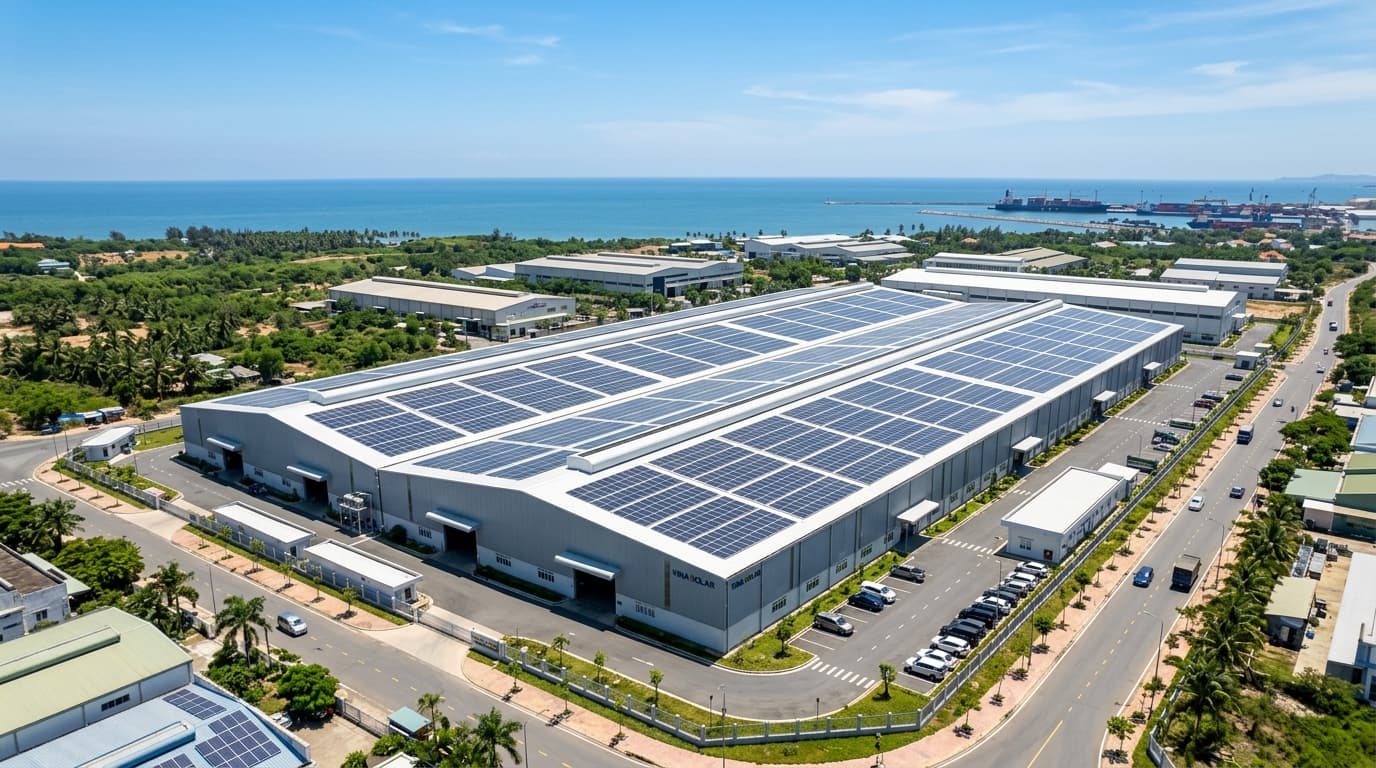
Bac Ninh is stepping up rooftop solar for over 400 enterprises with a target exceeding 811 MW, opening up opportunities for cost optimization and sustainable green transition.
Bac Ninh Accelerates Commercial Rooftop Solar
The Provincial People's Committee and relevant departments in Bac Ninh are accelerating programs to promote rooftop solar installations at manufacturing facilities and industrial zones. This direction not only helps alleviate pressure on the national power grid but also provides practical momentum for manufacturing units to meet green standards within global supply chains.
Bac Ninh Targets Over 800 MW of Rooftop Solar for Factories
According to a report from the Department of Industry and Trade of Bac Ninh Province, the locality currently ranks among the leading northern provinces in on-site distributed energy generation. As of Q3/2026, the province has reached nearly 300 MW of commercial operating capacity, achieving approximately 89.2% of the previously registered total capacity.
To continue facilitating industrial facilities' transition toward clean energy autonomy, the province has phased its implementation plan into two stages:
-
Phase 1 (implemented through the end of 2026): Focus on reviewing daytime consumption loads and assessing structural infrastructure readiness at key factories.
-
Phase 2 (implemented through the end of 2027): Expand broadly across concentrated industrial parks and industrial clusters.
A total of 417 enterprises are listed in the investment orientation with a minimum total capacity reaching 811.5 MW. Enterprises with high load demands can fully register for capacities higher than the indicative target, provided the technical design ensures operational safety.
Legal Framework from Decree 135 Drives Self-Production and Self-Consumption
Bac Ninh's acceleration of rooftop solar development takes place against the backdrop of an increasingly complete legal framework for renewable energy, notably the Government's Decree 135/2024/ND-CP on incentive mechanisms for self-produced, self-consumed rooftop solar.
This regulation eliminates many previous administrative barriers for factories within industrial parks and clusters. When a system is constructed to serve on-site operations directly, grid connection and registration procedures are significantly streamlined, giving investors confidence to devise long-term strategies.
For manufacturers exporting electronic components, precision mechanics, textiles, or packaging, shifting a portion of their energy to clean electricity also yields emission reduction certificates (such as I-RECs or compliance with CBAM mechanisms), substantially enhancing competitive capacity during international contract bidding.
Practical Benefits and Economic Analysis for Factories
Unlike previous commercial investment models centered on selling power back to the grid, the current commercial rooftop solar model focuses squarely on on-site consumption:
-
Capitalizing on existing roof space: Tens of thousands of square meters of metal workshop roofs provide natural thermal insulation for the production floor below while generating clean electricity throughout the day.
-
Mitigating peak-hour energy costs: Peak generation hours for solar systems (roughly 10:00 AM – 2:00 PM) frequently coincide with peak tariff windows for industrial electricity. Maximizing solar consumption helps substantially curtail grid electricity bills.
-
No one-size-fits-all payback estimate: At SVP Solar, we always emphasize that every project features a unique load profile. Actual financial efficiency, savings ratios, and payback periods depend entirely on daytime consumption patterns, structural mounting design, equipment selection, and thorough site survey results.
Critical Safety and Technical Considerations for Enterprises
To ensure a commercial rooftop solar installation operates reliably for 20–25 years, SVP Solar engineers recommend that businesses pay special attention to three foundational elements:
-
Structural Integrity Verification: Factory roofs must undergo thorough testing for both dead loads (solar panels, mounting rails, accessories) and live/dynamic loads (wind, storms) prior to installation.
-
Fire Prevention and Fighting (PFP) Standards: The design must maintain emergency escape pathways, clear access for firefighting personnel, module-level rapid shutdown (RSD) devices, and compliant lightning protection grounding systems.
-
Monitoring and Power Control Equipment (Zero Export): If reverse feed into the grid is restricted or capped, the inverter system must integrate an intelligent controller to follow real-time load demand dynamically.
Enterprises in Bac Ninh seeking to evaluate rooftop feasibility and technical solutions can contact SVP Solar for transparent, safe load measurement and on-site survey support.