
Does Solar Power Cause Noise Pollution?
10/03/2026 · 4 min read
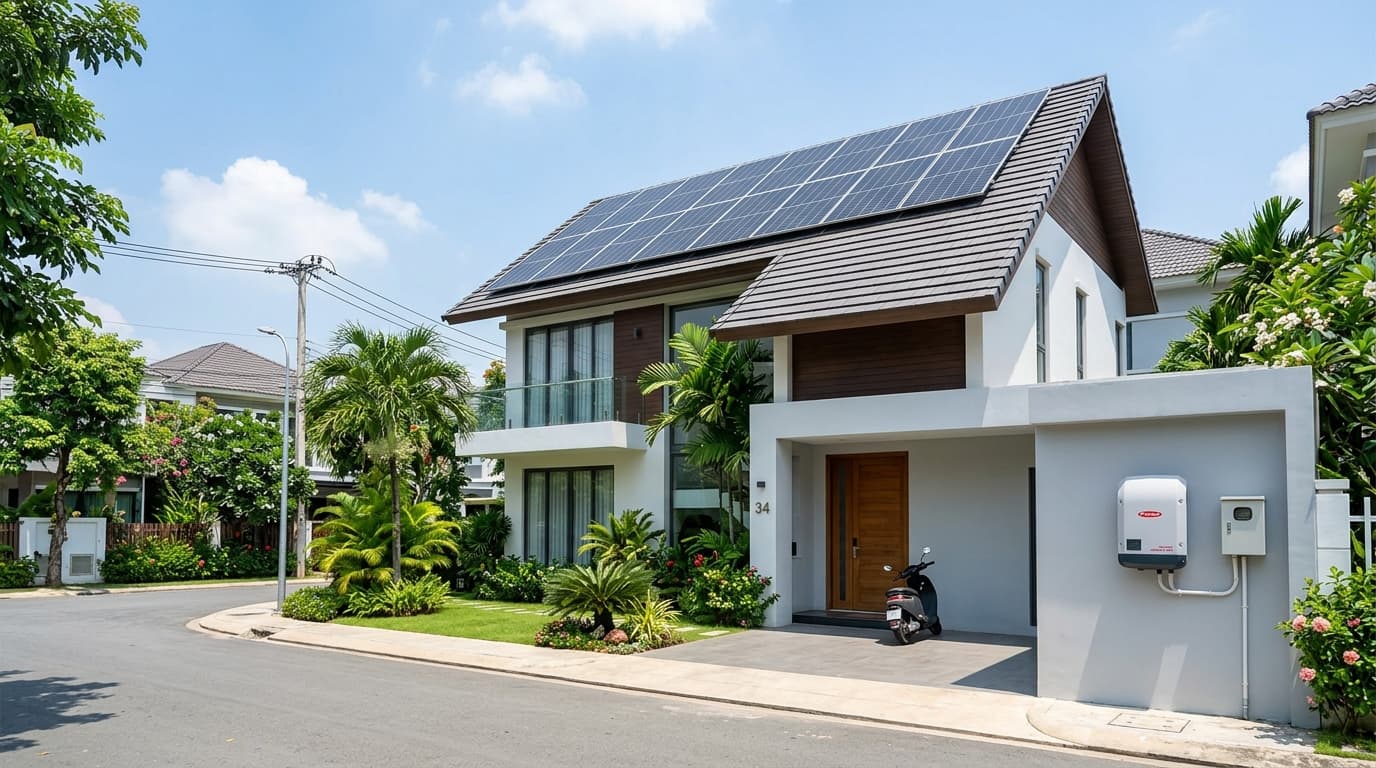
Does a solar power system cause noise pollution in your daily life? Join SVP Solar to discover actual sound levels and optimal equipment layout solutions.
Does Solar Power Cause Noise Pollution?
When exploring renewable energy installations, many homeowners wonder whether operating equipment causes noise pollution that disrupts their living space. This concern is completely understandable, as peace and quiet in family life are always a top priority. With extensive experience in installing and operating numerous real-world projects, SVP Solar clarifies the sound emission mechanisms within the system so that customers can have the most accurate understanding.
Do solar panels make noise?
The short answer is absolutely not. Photovoltaic (solar) panels operate based on the photovoltaic effect: photons of light excite electrons in silicon photovoltaic cells to generate direct current (DC).
Unlike wind turbines that require rotating blades or diesel generators that utilize internal combustion pistons, solar panels are 100% static components containing no moving mechanical parts. Consequently, the process of absorbing radiation and generating electricity on the roof takes place in absolute silence, without producing any ambient noise or hum.
Actual sources of sound in a solar system
If the panels do not produce sound, where does noise in the system come from? In reality, sound can only originate from certain conversion and control devices:
-
Inverter: This device converts direct current (DC) from the panels into alternating current (AC) for household appliances. During the conversion process, inductors and electronic components vibrate slightly at high frequencies, creating a very faint hum. In addition, higher-capacity inverters feature cooling fans to dissipate heat when operating at peak capacity under intense midday sun. The noise level of a residential inverter typically ranges between 25 and 45 dB, equivalent to rustling leaves or a whisper. After sunset, the inverter automatically shuts down or enters standby mode with a noise level of 0 dB.
-
Transformers (for large-scale stations): In utility-scale solar farms or industrial plants, step-up transformers experience magnetostriction, emitting a low-frequency hum. However, these devices are always housed in dedicated substations located far from residential areas.
-
Tracking Systems (Trackers): Some ground-mounted projects utilize automatic tracking systems to follow the sun. The mechanical motors emit intermittent sounds for a few seconds when adjusting the tilt angle, which is virtually negligible.
Do solar power systems really cause noise pollution?
According to the National Technical Regulation on Noise (QCVN 26:2010/BTNMT), the maximum allowable limit in normal areas (residential areas, houses) is 70 dBA during the day and 55 dBA at night. For areas requiring special quietness (hospitals, schools), this threshold is 55 dBA and 45 dBA, respectively.
For comparison:
-
A whisper: around 30 dBA.
-
A quiet refrigerator running: around 40 dBA.
-
A residential inverter running at full capacity: around 35 – 45 dBA (at a distance of 1 meter).
-
An outdoor air conditioning unit: around 55 – 65 dBA.
-
Street traffic noise: between 70 – 80 dBA.
When standing 2 meters or further away from the inverter, the sound from the cooling fan virtually blends into the natural ambient background noise. At night—the time when maximum quiet is needed for rest—the system stops generating electricity entirely, producing zero sound. Therefore, a solar power system cannot be considered a source of noise pollution.
Optimal equipment layout solutions from SVP Solar
Even though sound levels are extremely low, scientific planning of installation locations remains essential to completely eliminate any discomfort for homeowners. The SVP Solar engineering team consistently adheres to strict design principles:
-
Selecting appropriate cooling technology: For residential solar power systems, we prioritize high-quality inverters that utilize passive cooling mechanisms (fanless), ensuring exceptionally quiet operation.
-
Smart installation placement: Avoid mounting the inverter on shared walls of bedrooms or private home offices. Ideal locations typically include technical utility areas, well-ventilated spaces under stairs, garages, or covered balconies.
-
Vibration dampening: Mount equipment on dedicated brackets with anti-vibration rubber pads and securely tighten bolts to prevent acoustic resonance through the wall structure.
Every home has its own unique spatial and structural characteristics. Based on actual on-site surveys, our engineers will propose an optimal layout scheme balancing both high performance and maximum tranquility for your family. If interested, please contact SVP Solar for detailed technical consultation.